Repair-shop lead operations
Auto Repair Estimate Handoff Audit Before More Shop Leads
A repair inquiry can look resolved while the customer's concern, diagnostic authorization, inspection finding, estimate version, approval state, or next owner remains unclear. Trace those handoffs before increasing lead volume or automating follow-up.

The customer concern is not the diagnosis
“Brakes squeal,” “battery keeps dying,” and “the warning light came back” are useful starting points. They are not confirmed causes, approved work, or completed repairs. Yet those stages often collapse into one shop-management label. A web form becomes a ticket, a ticket inherits a generic service category, and the category later looks like a diagnosis. Once that happens, a follow-up tool may contact the customer about work that was never inspected or authorized.
An auto repair estimate handoff audit begins by preserving the customer's language and keeping later professional findings beside it. If a service adviser corrects the vehicle year, adds a safety symptom, or learns that the car was already inspected elsewhere, that change needs its own event. The original intake should remain visible. It explains what the shop knew when the first response was made.
This discipline is not about distrusting the service desk. It gives advisers and technicians a shared record that can survive a shift change, a voicemail, a rescheduled drop-off, or a revised repair plan. It also keeps an awkward but important state available: unknown.
Build a minimal intake-and-scope card
A useful first card is smaller than the full customer or vehicle file. It can contain a stable review ID, the customer's exact concern, intake channel and time, a redacted vehicle reference, requested timing, whether the vehicle is drivable as reported, relevant warning or safety conditions, appointment or drop-off state, and the next accountable owner. It should not copy every field merely because the system can export it.

| Field | Evidence to preserve | Do not infer | Possible hold |
|---|---|---|---|
| Customer concern | Original wording, source event, later correction, reported symptoms | A mechanical cause or repair recommendation | Safety wording or facts need qualified review |
| Vehicle reference | Minimum record key needed to distinguish the vehicle | Ownership, identity, warranty, or history from a partial match | Vehicle or customer mismatch |
| Diagnostic authorization | Proposed scope, stated charge or limit if applicable, authorizing event, time, owner | Approval from an appointment or vehicle drop-off alone | Authority or scope unclear |
| Inspection findings | Technician evidence, date, test or observation reference, recommendation | That every recommendation entered the estimate | Finding lacks accountable source |
| Estimate version | Stable version, included work, revision reason, preparer, customer-facing event | Approval, delivery, or currentness from file existence | Silent overwrite or missing version |
| Decision and work state | Approved, declined, unknown, work ordered, started, completed, paid | That one state proves another | Missing approval or state conflict |
| Owner and next action | Accountable role, due condition, review date, stop or release rule | Responsibility from shared inbox visibility | No accountable owner |
Use a mixed sample, not a showcase
Start with a handful of recent records selected by a written rule. Include one ordinary appointment, one inquiry that changed after inspection, one estimate that the customer questioned, one record that went quiet, and one with conflicting or missing evidence. The purpose is not to calculate a shop-wide failure rate. It is to see whether the same evidence chain can explain different paths.
A clean completed repair is useful, but so is a supported decline. A cancellation, an unsupported vehicle, a warranty referral, a duplicate request, or a customer instruction not to continue should stay visible. A repair shop lead management process becomes more trustworthy when it preserves negative and uncertain outcomes instead of converting every open record into an opportunity.
Record the sample dates, filters, and exclusions. If the records expose unrelated problems, name them separately. A missing diagnostic authorization, a stale estimate version, and an unowned callback are three findings, not one vague “bad lead” diagnosis.
Run the six-step handoff audit
- Freeze a mixed sample. Choose a small set of recent repair inquiries that includes routine, revised, quiet, declined, and conflicting paths. Record the sample dates and selection rule.
- Preserve the original concern. Keep the customer's own description, intake source, vehicle reference, requested timing, warning conditions, and later corrections separate.
- Trace diagnostic authorization. Record what diagnostic work was proposed, who could authorize it, what event supports authorization, and any limit or unresolved condition.
- Connect findings to estimate versions. Tie each inspection finding and recommendation to the estimate version, preparer, revision reason, and customer-facing event it supports.
- Separate every decision state. Keep estimate prepared, sent, customer approved, declined, unknown, work ordered, work started, completed, and paid as distinct states.
- Issue a bounded audit receipt. Record supported facts, unknowns, owner, next action, review date, and any safety, identity, complaint, stop, or missing-approval hold.
Diagnostic authorization needs its own evidence
An appointment says a visit was planned. A drop-off says the vehicle arrived. Neither event, by itself, explains what diagnostic work the customer authorized. Preserve the proposed diagnostic scope, the customer-facing explanation, any stated charge or limit, the authorizing party, the supporting event, and the time. If the shop uses signatures, recorded calls, portal actions, text replies, or another accepted method, the audit should reference the event rather than reinterpreting it.
The Federal Trade Commission's current Auto Repair Basics consumer guidance advises customers to ask how a shop prices work, whether a diagnostic charge applies, and what a written estimate includes. It also says a written estimate should identify the condition to be repaired, needed parts, and anticipated labor, and should address approval before work exceeds a specified amount of time or money; the FTC notes that state law may require this. That guidance supports a practical workflow point: diagnostic scope, written estimate, and later approval are related records, but they are not interchangeable.
The audit should not decide whether a particular interaction satisfies a law or contract. If authorization is disputed, missing, or tied to a safety concern, preserve the evidence and place the route on hold for the appropriate owner. Do not manufacture a clean state to keep automation moving.
Version the estimate; never overwrite the decision trail
Inspection can change the work under discussion. A visible component may explain one symptom while testing reveals another condition. A customer may ask for an alternative, postpone non-urgent work, or authorize only part of a recommendation. The estimate record should show how those decisions developed without turning a later version into a false history.
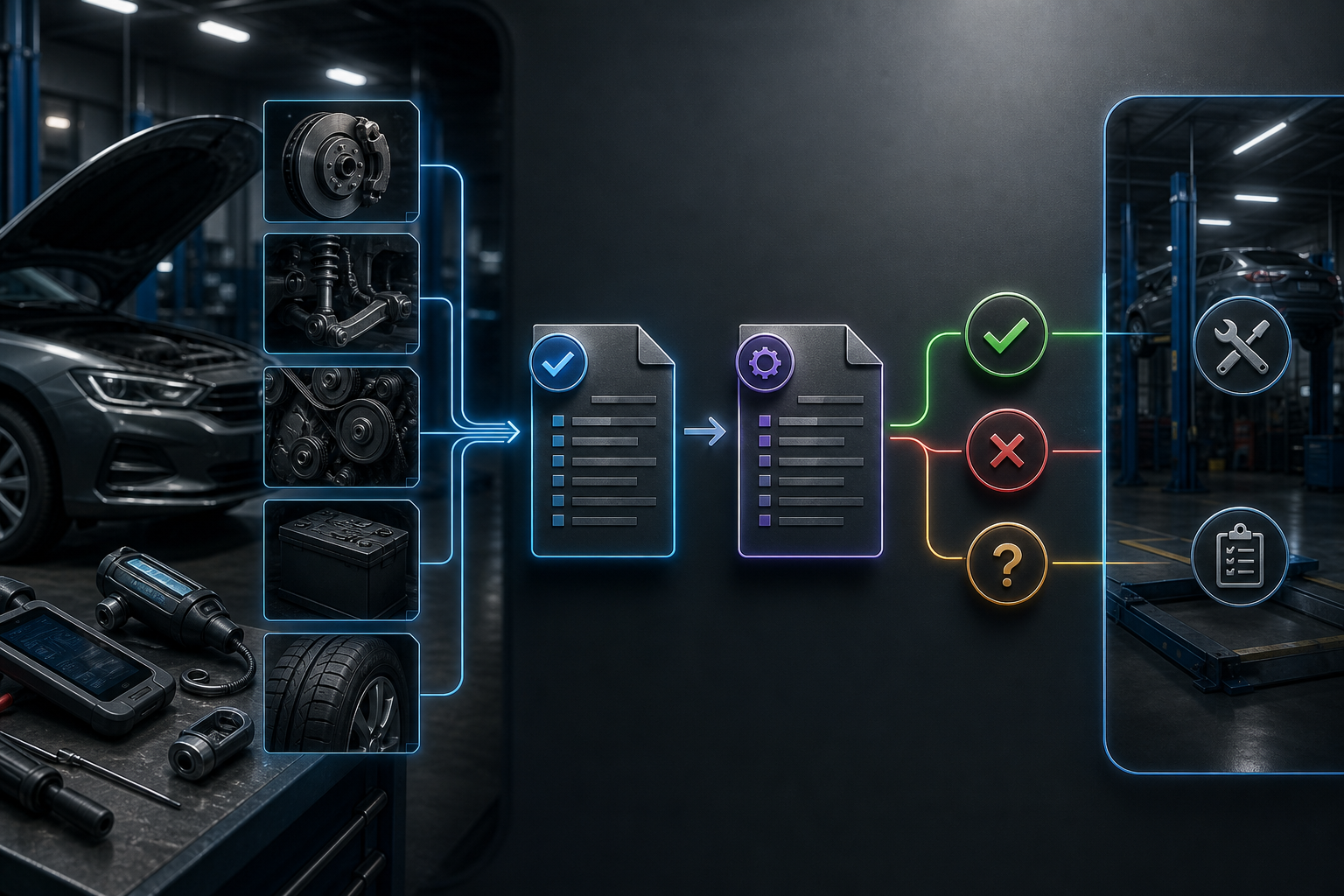
For each version, keep a stable reference, creation time, preparer, supporting inspection findings, included work, exclusions or deferred items, revision reason, customer-facing event, current decision, and next owner. Earlier versions or an authorized change log should remain available. A single undated PDF named “final” cannot explain which scope a customer saw or what changed.
Prepared is not sent. Sent is not delivered. A portal view is not necessarily informed approval. Approval is not a work order. A work order is not evidence that work started. Started is not completed, and completed is not paid. A system may not capture every event, but it can use the narrowest supported label. Unknown is safer than silently joining two states.
This separation also protects follow-up quality. A customer who declined one item should not receive a message that implies the whole estimate is pending. Someone waiting for a revised version should not be treated as unresponsive. A completed repair should not remain in a new-lead sequence because an earlier marketing record was never reconciled.
Minimize customer and vehicle data in the review packet
Repair records may include names, contact details, addresses, license plates, VINs, payment context, photos, diagnostic data, warranty material, and private notes. A first-pass workflow review rarely needs the whole file. The FTC's Protecting Personal Information guidance tells businesses to understand the personal information they hold, keep only what they need, and limit access according to need.
Use a stable audit ID instead of a name where possible. Redact a VIN or use the shop's internal vehicle key if the full identifier is unnecessary. Crop or mask license plates and personal items in inspection imagery. Replace exact addresses with a service-area indicator when location is not part of the question. One redacted estimate and one redacted event chain can often establish a handoff gap without an unrestricted shop-management export or mailbox history.
End with a receipt another operator can challenge
The useful output is not a dramatic lead score. It is a small receipt containing the sample window, record key, original concern reference, diagnostic-authorization state, inspection evidence reference, current estimate version, last verified customer event, decision state, work state, owner, next action, unresolved fact, review date, and hold or stop reason.

Use plain dispositions: supported, needs correction, missing context, hold, and stop. “Supported” means the sampled evidence can explain the current state; it does not certify the repair, prove customer satisfaction, or predict revenue. “Needs correction” identifies a factual record repair. “Missing context” names the smallest fact needed. “Hold” blocks the next automated or operational step until a release condition is met. “Stop” preserves a cancellation, wrong party, do-not-contact instruction, complaint boundary, duplicate, safety issue, or other reason the ordinary path should not continue.
An owner should be a role or person with authority to decide the next step, not simply anyone who can see the inbox. The receipt should also define when the record will be reviewed again. Without a review condition, a hold can become a forgotten queue rather than a safety control.
What this audit can—and cannot—support
A bounded audit can show that concerns were normalized too early, diagnostic authorization is hard to trace, inspection findings do not map to estimate lines, versions were overwritten, customer decisions are ambiguous, work states conflict, or follow-up lacks an owner. It can also show that the sample is internally consistent. Those are actionable record findings.
The same sample cannot establish technician fault, customer intent, legal compliance, platform fault, account-wide lead quality, campaign incrementality, approval probability, labor utilization, final repair quality, margin, revenue, or return on ad spend. Marketing analysis requires a defined time period, complete cost and outcome data, stable stage definitions, and an appropriate comparison method. Clean handoffs make that later work possible; they do not predetermine its answer.
Sometimes the correct next step is small: repair one state definition, add an owner field, preserve estimate versions, sample again, and leave the lead budget unchanged. Cleanup does not require contacting an old customer, reopening declined work, altering a supported outcome, or adding automation.
Frequently asked questions
What should an auto repair estimate handoff audit check?
Check the original concern, intake event, diagnostic authorization, inspection findings, estimate version, customer-facing event, decision state, work-order state, accountable owner, next action, and any hold or stop signal.
Does a prepared repair estimate prove customer approval?
No. A prepared estimate proves that a document exists. Keep preparation, sending, customer questions, approval, decline, unknown, work authorization, work started, completion, and payment as separate events.
Are auto repair estimate and authorization requirements the same in every state?
No. Requirements can depend on state or local law, the service agreement, warranty or service-contract terms, and the facts of the repair. Verify the rules that apply to the actual transaction.
Can a small repair-shop audit prove that more leads will be profitable?
No. It can reveal evidence and workflow gaps, but it cannot establish lead quality, customer intent, approval probability, labor utilization, margin, revenue, or return on ad spend.
What should stay out of the first repair workflow review packet?
Exclude passwords, one-time codes, payment-card data, government identifiers, full customer lists, unrestricted inbox or shop-management exports, complete VINs when a redacted reference suffices, precise addresses, license-plate images, and unrelated vehicle or customer notes.
Primary sources
- Federal Trade Commission — Auto Repair Basics (consumer guidance on diagnostic charges, written estimates, approval, parts, warranties, and dispute documentation; accessed August 8, 2026).
- Federal Trade Commission — Protecting Personal Information: A Guide for Business (data inventory, minimization, access, security, and disposal guidance; accessed August 8, 2026).