Missed calls without recordings
Can AI Cleanup Doctor review missed calls if we do not record calls?
Last updated:
Yes. Start with the contact path, a small redacted call log and the notes that show what happened next. You do not need to share private audio to examine a missed handoff.
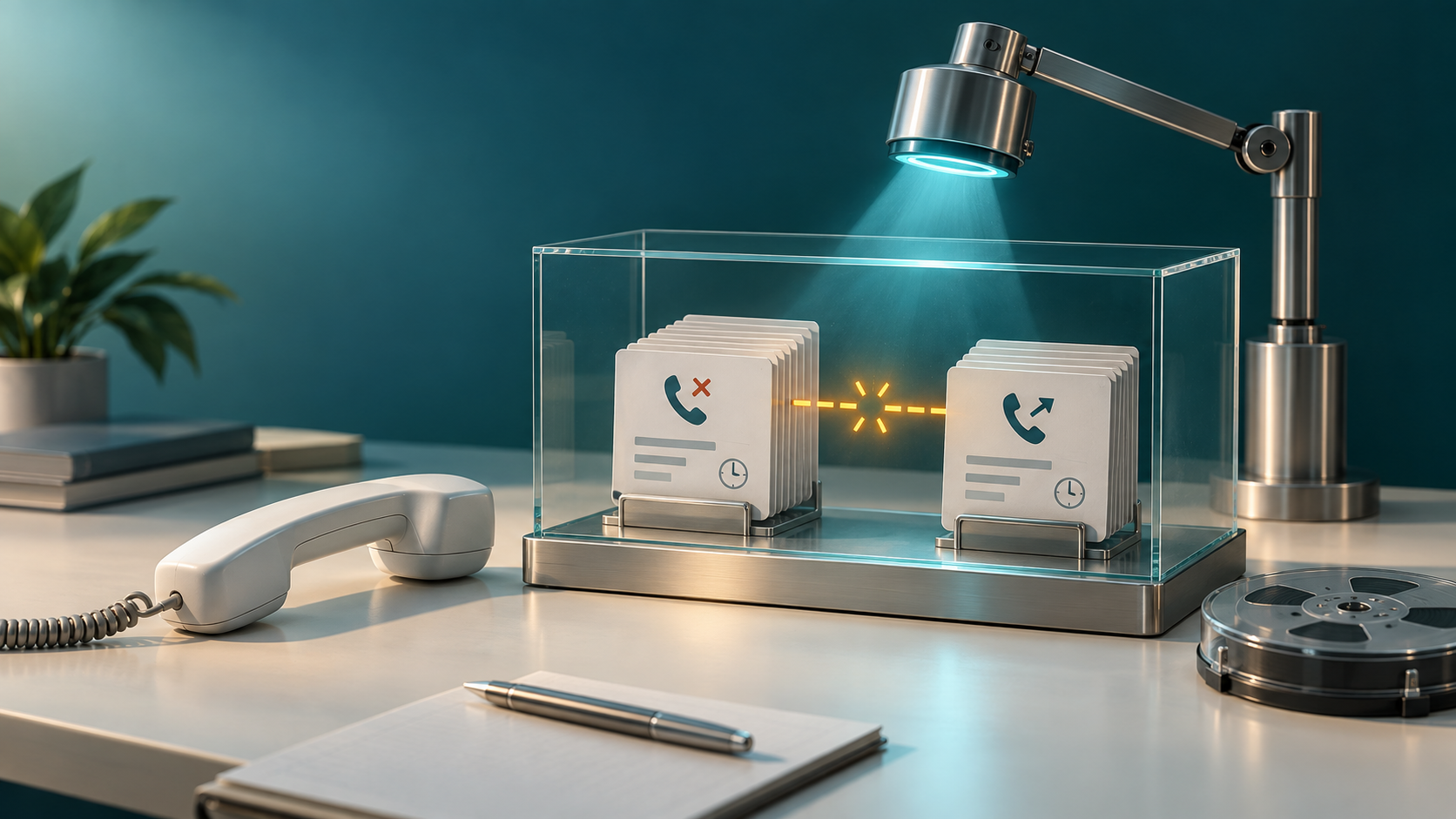
AI-generated conceptual illustrations use medical-diagnostic tools as a metaphor for reviewing a business workflow. They are not software screenshots, customer evidence or medical advice.
What the first review can answer
A missed call leaves evidence outside its recording. The number may appear on a website or directory. The phone system may record its time and status. A team member may leave a callback note.
Look for the point where the record stops. A voicemail may have no callback note; an after-hours call may have no assigned role. An unfamiliar source label may need an explanation from the office.
These records cannot tell you everything the caller said. If the available material does not establish a detail, leave it out of the finding and note the question that remains.
Why owners ask about recordings
You may not record calls, or you may prefer not to share audio with a new vendor. A first review can stay focused on the process you can document without it.
Start with one question you want answered. For example: does an after-hours voicemail reach the person responsible for the next working day? That question sets a narrower scope than sending every call your business has received.
| Question | What to check |
|---|---|
| Which public number did the caller use? | Compare the website, ad, Google profile and directory paths. Preserve an unknown source as unknown. |
| How did the phone system label the event? | Check its definitions of missed, abandoned, answered and voicemail. These labels are not interchangeable. |
| Who owned the next step? | Look for an assigned person or role, including an after-hours rule. |
| Was a message available? | A redacted summary may show what the office needed to route the request. |
| Was it a new inquiry or something else? | Separate quote requests from support, wrong-service calls, spam and duplicates when the evidence allows. |
| What happened after the first attempt? | Check the callback note and the business's approved follow-up rule. |
What to prepare without recordings
Begin with a public contact page and a short note about how the office handles missed calls. Add a redacted record only when it helps explain the question you want reviewed.
| Material | What it can show |
|---|---|
| Public website or directory page | Where the phone number appears and how the contact path works. |
| Small redacted call log | Time, source, status and recorded follow-up without customer identifiers. |
| Short redacted voicemail summary | The request category needed for routing, without private message detail. |
| Follow-up note examples | What the team recorded after a callback attempt. |
| CRM or spreadsheet labels | Whether the team uses the same status definitions. |
| Office process note | Who checks voicemail, who calls back and what changes after hours. |
Check whether public numbers agree and whether their mobile call links work. Then trace one voicemail into the office queue. An old listing or a missing note may explain a gap, but each needs checking before it becomes a finding about your business.
Keep source and status separate. An ad is a source; missed or answered is a status. Mixing those labels can make a straightforward callback question harder to trace.
A call-log sample you can adapt
Leave out customer names, phone numbers, addresses and private job details. For the number called, a label such as "main office" can describe the route without copying customer data.
Fictional example records: every row below is invented to explain the format, not taken from a customer review. Use relative days and role names when exact dates or identities are unnecessary.
On a narrow screen, scroll the table sideways to see the owner and next-step columns.
| When | Source | Number label | Status | Message | Owner | Next-step note |
|---|---|---|---|---|---|---|
| Day 1, morning | Google profile | Main office | Missed | Yes | Office manager | One callback attempt; no answer |
| Day 1, after closing | Website urgent-repair page | Tracking number | Voicemail | Yes | After-hours role | Escalation rule needs checking |
| Day 2, morning | Paid call campaign | Ad call number | Answered | No | Sales desk | Quote requested; next owner not recorded |
| Day 2, afternoon | Directory listing | Old number | Missed | No | Unknown | No assignment found in sample |
| Day 3, morning | Website contact page | Main office | Abandoned | No | Unknown | Check phone system's status definition |
You can add approximate timing or duration if it helps answer the question. Check what each duration field means: ring time and conversation time are different measurements.
A missing callback note is a gap in the record. It is not proof that an employee failed to call. Confirm that distinction before treating a row as an operational failure.
| Pattern in the sample | Question to investigate |
|---|---|
| Missed calls have no owner | Was anyone assigned outside this log? |
| Voicemail exists but no note follows | Did the message enter another queue? |
| After-hours calls use the daytime queue | Does a separate coverage or escalation rule exist? |
| A directory lists an old number | Does that number still route to the business? |
| Paid calls have no source detail | What can be verified before making a budget decision? |
What not to send
The first scan does not need your phone-system login or a full customer export. Leave out:
- Passwords, security codes and account administrator access.
- Call recordings, recording links and full private message threads.
- Customer names, phone numbers, addresses and payment information.
- Medical, legal, insurance, tax or other sensitive records.
- Employee discipline notes and unrelated personal details.
- Anything you do not have authority to share.
The First Scan Readiness page describes the intake boundary. Read it before preparing a sample.
If later work needs more information or account access, agree on a separate scope first. A request for a small review is not permission to expand access.
Check the redacted copy before sharing it
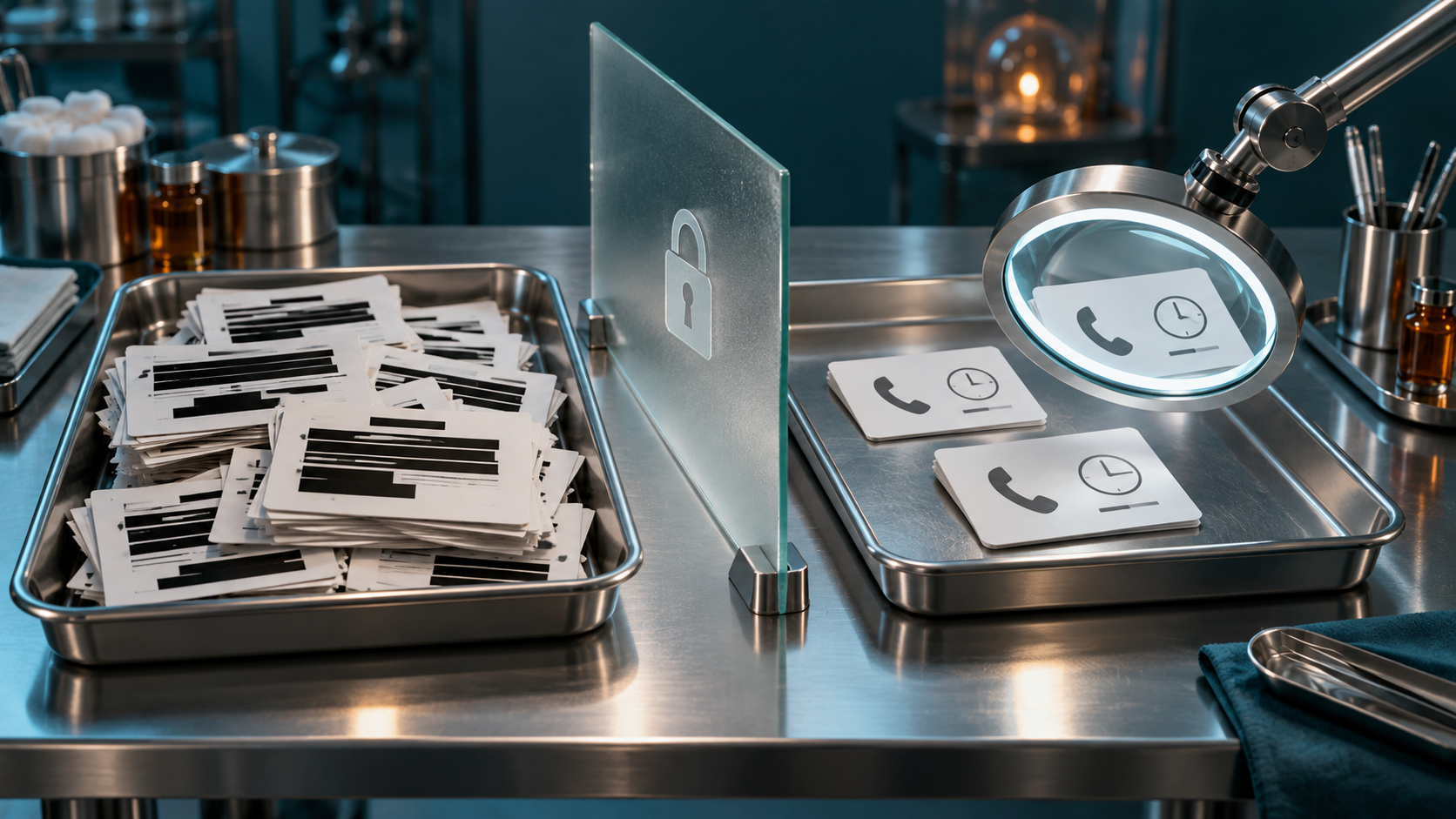
Do not assume a sample is anonymous because you replaced the customer name. A detailed note, unusual job or combination of dates and locations may still identify someone. Omit detail that the review does not need.
The FTC's guide to protecting personal information recommends limiting the personal information a business keeps to what it needs. For this review, that means explaining the workflow without attaching a full customer history.
| Field | Preparation choice |
|---|---|
| Customer name or phone number | Omit it. Use a neutral row reference only if needed to discuss that row. |
| Address or exact location | Omit it unless a broad service-area label is necessary for the agreed question. |
| Private job or message detail | Use a short category, such as "quote request," and leave out identifying details. |
| Date and time | Use relative days or broader time windows when exact timing is unnecessary. |
| Recording or shared-document link | Leave it out of the first-scan sample. |
| Staff information | Use the responsible role rather than personal or disciplinary information. |
Retain the source label, status, message yes/no, responsible role and short next-step note where relevant. Mark missing information as unknown rather than filling it from memory.
Review the actual file or screenshot you plan to send. Check surrounding rows, hidden columns, comments and unrelated screen content. If you cannot confidently limit it, send the public page and a short process question first.
When recordings might matter later
A recording may be relevant to a different question, such as the exact instructions a caller received or the wording of a disputed conversation. A call log cannot settle those questions.
Other questions may concern a voicemail greeting, call qualification or requests for services the team does not offer. Start by asking whether a public greeting, process note or redacted summary can explain the issue.
This article does not determine whether you may record, retain or share audio. Before any later audio review, confirm the scope, authority and applicable requirements with an appropriate adviser. Do not attach recordings to the initial inquiry.
Separate lead quality from follow-up quality
A caller can be outside your service area and still reveal a routing problem. A suitable inquiry can have a complete callback record even when no job is booked. Keep those outcomes separate.
When a source is unknown or a note is missing, the review should say so. A handful of rows cannot establish whether an advertising campaign is profitable or whether a staffing change will increase sales.
| Status | Owner question |
|---|---|
| Missed, no voicemail | What contact, if any, is appropriate under the business's approved consent and follow-up rules? |
| Missed, voicemail available | Who owns the callback and where should its note appear? |
| Answered, no outcome note | Can the business verify what happened without guessing? |
| Wrong service | Was the request outside scope, and is that supported by the available record? |
| Existing customer | Should support or warranty work be separated from new inquiries? |
| Urgent request | Does the business have an approved coverage and escalation rule? |
| Possible duplicate | Has the business verified that the records concern the same request? |
The scan does not send callbacks or texts. Any proposed customer contact still needs owner approval and the business's applicable consent and contact rules.

First-scan checklist
Before ordering, prepare a public contact page and one question you want the review to answer. If a record sample is needed, keep it within the agreed scope.
- Check the public phone path on desktop and mobile.
- Include relevant homepage, contact, service-area or quote-page URLs.
- Choose the fewest redacted rows that explain the question.
- Keep source labels honest, including "unknown" where necessary.
- Include message yes/no, the responsible role and a next-step note.
- Distinguish after-hours or urgent requests using the business's definitions.
- Review the outgoing sample and leave out recordings, secrets and private customer data.
The current $197 AI Leak Scan covers up to 25 redacted lead records. Twenty-five is a maximum for that package, not a minimum you must collect. Missing fields can be part of the review, but they limit the conclusions it can support.
What the findings should look like
A useful finding names the evidence, the gap and the next check. It should distinguish something observed from something the owner still needs to confirm.
| Review area | Example of a specific finding |
|---|---|
| Public contact path | Two public pages display different numbers; confirm whether both route correctly. |
| Mobile call link | The displayed number and tap-to-call destination differ on the checked page. |
| Source and status | The sample uses one field for both ad source and call outcome; separate their definitions. |
| Assignment | The sample has no responsible role for an after-hours row; check the separate coverage process. |
| Callback notes | No next-step note appears in the supplied row; ask whether another system holds it. |
| Sample boundary | The export includes unrelated personal detail; prepare a narrower version before review. |
The report can recommend what to inspect or clarify next. It should not blame an employee, judge an ad source or promise recovered work from incomplete evidence.
Related tools and reading
For response timing, the Lead Response Time Calculator is a planning aid, not a prediction of booked jobs.
For message handling, read contractor voicemail cleanup before scaling paid calls.
Before requesting a scan, review First Scan Readiness and the current scope on the order page.
The privacy policy and service terms explain the service boundaries. This article does not add a retention, confidentiality or outcome promise beyond those terms.
FAQ
Do you need call recordings for the first review?
No. The first review can start with public contact pages, redacted call logs, short message summaries and follow-up notes. If those materials do not answer a question, the report should say what remains unknown.
Can we remove customer names and phone numbers?
Yes. Leave out customer names, phone numbers, addresses and private job details. Keep only the workflow facts needed for the agreed review. An alias alone does not make a record anonymous.
What if we only have screenshots?
A few checked, redacted screenshots can help. Start with the public phone path and a small call-log example, then explain who checks voicemail. A short typed process note may expose less information than a screenshot.
Can you tell whether our ads are bad from missed calls?
Not from missed calls alone. Source labels and follow-up notes can show gaps in the evidence, but they cannot establish ad quality, wasted spend or booked-job outcomes on their own.
Should we send phone-system admin access?
No. The first scan uses public context and a limited redacted sample. Any later access request needs a separate scope and owner approval. Do not send passwords or security codes.
Is this legal advice about recording calls?
No. AI Cleanup Doctor does not provide legal advice. Before recording or sharing calls, check the rules that apply to your business with an appropriate adviser. This first review does not require recordings.
What if our staff did call back but never wrote notes?
Record the callback as unverified until the business can confirm it. A missing note does not prove that nobody called. The review should distinguish a missing action from missing evidence of an action.
What is the smallest useful sample?
Begin with the public contact path, one follow-up question and the fewest redacted examples needed to explain it. The $197 AI Leak Scan covers up to 25 redacted lead records. That is a scope limit, not a required minimum or a claim that the sample is statistically representative.
Start with one follow-up question
Review the $197 AI Leak Scan scope, or email gking@stoga.com with your public website and the handoff you want checked. Do not attach private records to that first inquiry.
The scan provides an evidence map, open questions and a short next-action list. Its standard 48-hour window starts after payment, scope and the limited intake packet are confirmed.