AI search visibility for contractors starts with clear follow-up pages.
Before a roofing, HVAC, plumbing, restoration or remodeling company asks whether an AI answer mentions it, inspect what a buyer can actually learn from its service pages. A name in an answer is not a booked job, and an attractive page is not useful if the next call or form has no owner.
Last updated: October 15, 2026
A contractor can spend a month debating "AI optimization" while its website still says three different things about the service area. One page names the whole county. Another excludes two towns. The inquiry form accepts either address, but nobody knows what happens after hours. None of those gaps is fixed by repeating a keyword. The first task is to establish a service description the office will stand behind and a follow-up route it can perform.
This guide is an editorial and intake review, not a promise of AI citations, Google rankings, calls, booked work or revenue. It does not assume that any search provider has seen or endorsed a particular page. The examples below are hypothetical so the review can be adapted to a real contractor's records without inventing customers or results.
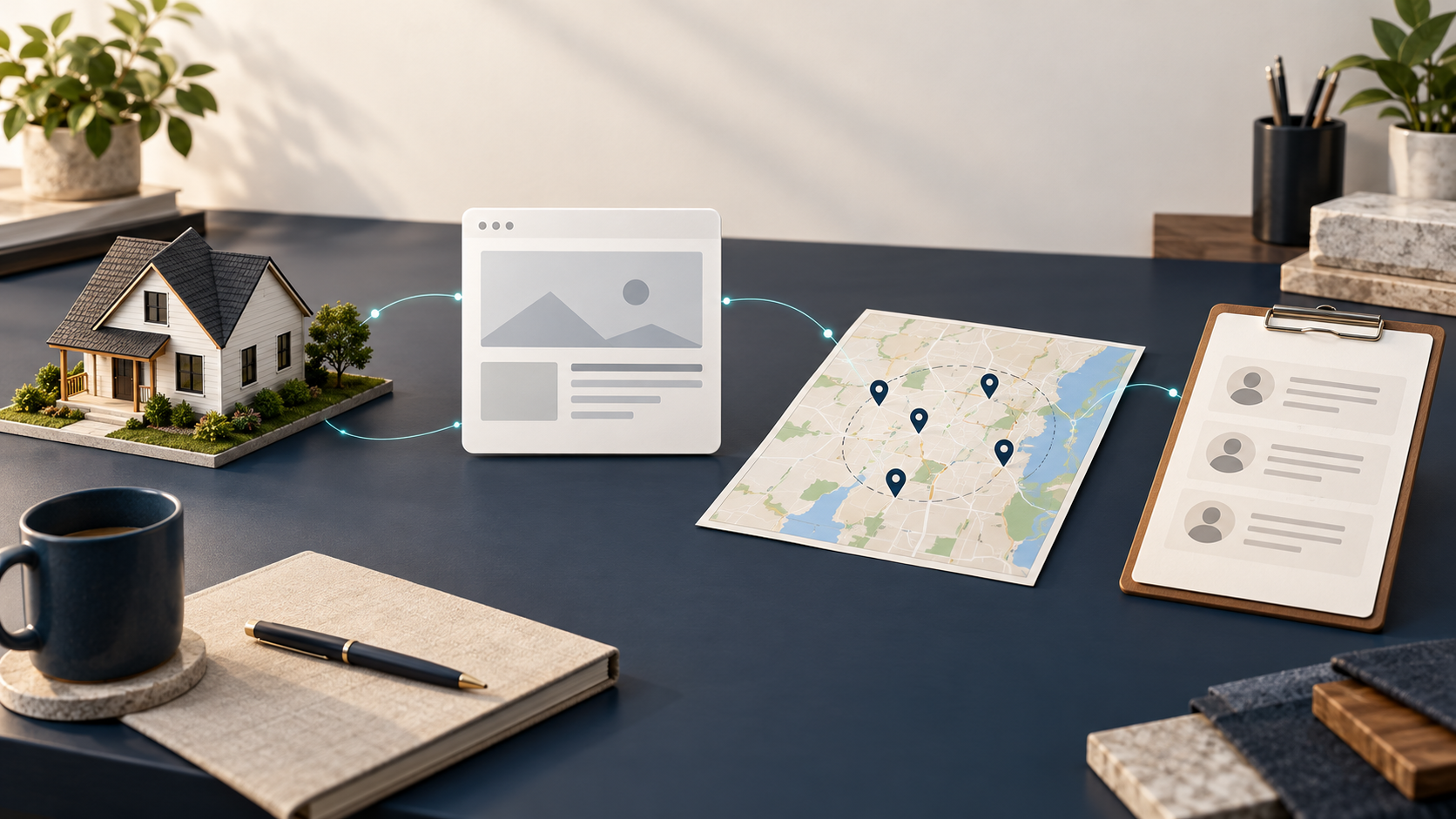
Start with the page a buyer would need
Write down one buyer question in plain language. For an HVAC company, it might be: "If the system stops cooling tonight, do you serve my address and what should I do next?" For a remodeling company, it may be: "Can I ask for an estimate before deciding on materials?" The answer belongs on the relevant service page, not in a disconnected list of phrases. A page should identify the service, who it is for, the area the business actually covers, any meaningful timing limits, and a clear way to ask for help.
Keep the answer narrow enough to check. "Emergency service across the region" is a poor substitute for an accurate coverage boundary when the dispatch team cannot serve every town. If evening calls go to a voicemail and a staff member reviews them the next morning, say so where that distinction matters. Do not imply 24-hour availability to win a query if the business cannot deliver it. An office can still write a useful page without claiming a response time it has never measured.
Compare the website with the business's public profile, advertisements and actual intake script. A coverage or service promise that appears in one place but not the others is a review item. It is not automatically evidence that the contractor broke a rule; sometimes an old campaign or seasonal page simply needs an owner. Record the exact URL, the conflicting sentence, the person who can confirm the truth and the revision decision. If that person cannot confirm the fact, leave the claim out of the public page.

Separate page proof from search outcomes
Different records answer different questions. A live URL can prove what the contractor currently says. A dated edit record can show when the wording changed. A form test can show whether a test inquiry reaches the intended destination. A Search Console report may show impressions and clicks for a property under Google's reporting definitions. None of those alone proves that an AI answer displayed the contractor, that the answer caused a lead, or that the lead became a sale.
Use a small proof register for each important page. Keep the page URL, the question it answers, the exact statement being checked, the person who confirmed the service fact, the date checked and the status. Status matters. A draft awaiting the contractor's approval is not a published page. A sitemap submission is not a crawl. A page that was crawled is not necessarily indexed. An observed AI answer is a dated observation from one test context, not a placement guarantee for every person or query.
There is no need to publish private call recordings or customer details to make a public page credible. The page can explain the process in general terms. Keep account-specific evidence in a restricted review record and redact it before sharing. If a claim depends on a real customer example or testimonial, obtain the relevant rights and permission first. Otherwise use a clearly labeled hypothetical example, as this guide does.

Connect an answer to a human follow-up
A search result can bring someone to a page, but the visitor still needs a sensible next step. If the page offers a call button, test that it reaches the right number on mobile. If it offers a form, confirm where a legitimate test submission lands and who can see it. Keep sensitive details out of test messages. Where the office uses an AI-drafted reply, a person should review wording that could make a scheduling, price, emergency or safety promise the business has not approved.
For example, imagine a homeowner reads an HVAC page after business hours. The page says the company serves the homeowner's town and provides an inquiry form. The office's actual process is to review those inquiries when staff return. The safe page explains that limitation, asks only for information needed to route the request and points emergencies to the appropriate real-world channel. It should not send an automatic "technician is on the way" message unless dispatch has actually confirmed one. This is a hypothetical workflow, not a report about a named customer or contractor.
The handoff record can be modest: submission time, contact permission, service location, issue category, owner, next action and outcome once known. Teams should avoid collecting more personal data just to fill a dashboard. They can start by tracing a redacted sample from the public page to the office queue. If the sample has no owner or the reply promises something unsupported, fix that specific problem before buying more traffic for the page.

Write useful answers, then make them easy to find
Google's SEO Starter Guide explains how to help search engines understand a site and how to help users decide whether to visit. Its people-first content guidance asks whether a page offers useful, reliable information for its intended audience. Google's AI features guidance describes the ordinary Search foundations as relevant to AI features too; it does not offer a special shortcut that guarantees inclusion in an AI answer. These are useful editorial tests, not a promise of visibility.
Give each substantial buyer question a home on the most appropriate page. Avoid creating near-identical town pages that change only the place name. Link a service page to the relevant coverage explanation, estimate process, contact path and terms. Use headings that match the answer below them. Put the important fact in readable text rather than only inside an image. A useful photo or illustration can support the explanation, but it cannot verify that a crew serves a town or that a dispatcher answered a call.
A sitemap can help Google discover URLs, as its sitemap documentation explains. Keep the sitemap tied to real content changes. A true revision date is helpful for readers and crawlers; changing a date merely because a daily task ran is not. Keep the page's visible update line and structured `dateModified` aligned when the content has actually changed. No sitemap, schema test or indexing request can guarantee that a particular page is indexed or cited.
A short review sequence for one service line
- Choose one live service page and one buyer question. Record its existing URL and do not change a published path to chase a keyword.
- Ask the service owner to confirm coverage, hours, scope and any terms that affect the answer. Hold unsupported claims.
- Open the page on a phone-size screen. Read the heading, answer and next step as a first-time visitor would. Test the contact path with a harmless sample.
- Compare the public profile and active ad copy with the page. Assign a person to resolve contradictions; do not silently change a business fact.
- Record what changed, when it changed and what remains open. Keep a direct link to the live page and a separate, redacted operational review.
Start small enough that someone can finish the review. One service line with three carefully checked pages is more useful than a spreadsheet of hundreds of phrases with no owner. For a roofing business that may be storm intake, estimates and ordinary repair coverage. For a plumber it may be service area, urgent calls and follow-up after a quote. The order should follow the real buyer journey and the office's ability to respond.
Measure observations without turning them into promises
After a page is published, keep measurement separate from sales claims. Record the page version and date, then look at available Search Console information and your own consented site analytics. If the page begins receiving visits or inquiries, trace only the records you are authorized to use. Check whether the inquiry was in scope and whether it received the expected human follow-up. A raw impression is not a lead. A form start is not a booked job. A booked job is not revenue until the business's own records support it.
If a page has no visible search activity, first ask a smaller technical question. Does the original URL return the intended page? Is it linked from relevant pages and present in the sitemap? Is a noindex directive or an incorrect canonical keeping it out of the intended set? Use the search provider's own inspection information where the property owner has access, and keep its status separate from your editorial notes. Do not keep changing the article date or submitting the same version in the hope that a queue will move faster. The next useful change may be a clearer answer on the page, a corrected link, or simply more time for a provider to process an already received sitemap.
AI answer appearances are especially easy to overstate. Answers can differ by query wording, location, device and time. If someone captures an example, record those conditions and the exact source link shown, if any. Do not multiply one screenshot into a claim about market share. The strongest near-term evidence is often less glamorous: a service page that is accurate, a contact route that works, and a response owner who can explain what happened next.
AI Cleanup Doctor's AI Answer Map is a planning aid for connecting buyer questions to pages. The sample reports show the style of a bounded review. If a contractor wants to consider a paid scan, the order page states the current scope and buyer safeguards. None of these routes promises a ranking, citation, number of leads or revenue result. The sensible first request is one real URL and one clearly described handoff problem.