Accountable automation
Automation Handoff Ownership: Name the Human Behind Every Action
A rule can run, a task can appear, and a message can be drafted while the customer handoff remains unowned. Accountability begins where technical success stops.

A task with no accountable owner is a new waiting room
Automation often looks complete from inside the tool. The trigger fired. The integration returned success. A task appeared in the CRM. The record moved from new to contacted. None of those events answers whether a qualified person accepted responsibility for the customer handoff.
Consider a web inquiry routed to a shared team. The automation may assign “Sales” and start a response timer. If three employees assume someone else is watching the queue, the row has an assignee label and no practical owner. When the timer expires, an alert sent to the same unowned group only repeats the design flaw.
Ownership must be observable. A named role knows which event begins responsibility, which evidence arrives, which decision is allowed, what completion looks like, how long the item may wait, where exceptions go, and who takes over when the owner is unavailable. The person does not need to perform every click. The person must be able to explain and control the outcome.
Separate five responsibilities that tools often compress
One label called owner can hide several jobs. The observer confirms that the event stream and queue are visible. The decision owner chooses what should happen under the business policy. The approver authorizes a sensitive or customer-facing action. The executor performs the approved action or supervises the system that does. The incident owner responds when behavior, evidence, or impact leaves the approved range.
A small business may assign several jobs to one person. The distinction still matters. It reveals conflicts and missing authority. A dispatcher may execute an approved scheduling response but lack authority to change service-area policy. An automation specialist may maintain the integration but lack authority to decide contact permission. A manager may own the process but need an on-call backup for urgent exceptions.

Write a handoff contract before writing another rule
A handoff contract is a plain-language operating definition. It states the event that starts the handoff, evidence required, accepting role, allowed decision, system action, human action, completion receipt, timeout, exception classes, escalation, fallback, and change owner. It is not a legal contract by itself. It is the operational agreement the automation must implement.
| Contract field | Question to answer | Weak pattern | Accountable pattern |
|---|---|---|---|
| Trigger | Which trustworthy event begins responsibility? | “When a lead arrives” | Named source event, timestamp, channel, and required fields |
| Accountable owner | Which role answers for the handoff result? | Shared team, vendor, or automation | One role plus backup and acceptance receipt |
| Decision boundary | What may this owner or system decide? | Broad “handle lead” instruction | Allowed states, prohibited actions, and escalation conditions |
| Completion receipt | What proves the responsibility ended correctly? | Rule-run success or status update | Accepted assignment, approved version, send, reply, booking, or other defined evidence |
| Timeout | When is the handoff overdue? | No clock or alert to the same group | Defined timer, recipient, escalation level, and fallback |
| Exception route | Where do missing, conflicting, unsafe, or unsupported cases go? | Generic manual review | Qualified class owner with evidence and response target |
| Change control | Who may alter the rule and how is it tested? | Silent live edit | Version, review, bounded test, approval, monitor, rollback |
Generated, accepted, sent, and answered are different states
AI-assisted workflows make state precision more important. A model output is a proposal. A human review is an evaluation. Approval is authorization for a defined version and action. A send event is an external attempt. Delivery is a channel-specific signal where available. A reply is a customer event. Booking, completed work, invoice, and payment belong to later business processes.
When a system moves directly from generated to contacted, it erases the approval decision and overstates the customer event. When it moves from sent to won, it invents a business outcome. Owners need a state vocabulary that prevents those shortcuts and an event trail that shows who or what caused each transition.
Unknown should remain available. A missing send receipt does not prove no contact occurred; a salesperson may have called outside the tracked channel. A missing reply does not prove no interest; the response may be in another inbox. Assign the unknown to an owner who can reconcile evidence rather than allowing the system to manufacture certainty.
Exception ownership requires subject authority
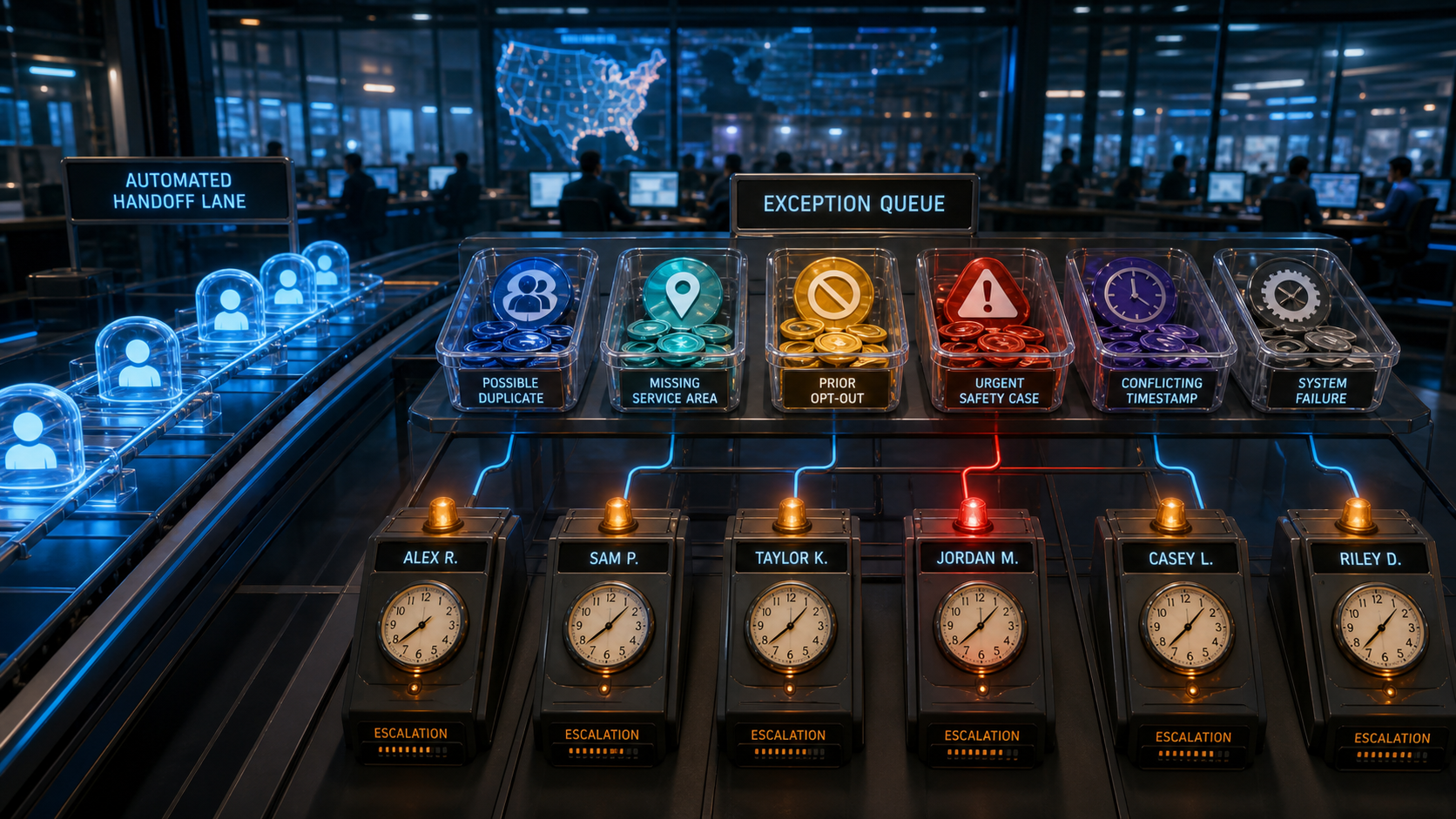
A single manual-review queue mixes incompatible work. A possible duplicate needs someone who can compare identity fields without triggering a second message. A prior opt-out needs a person with authority over suppression. A missing service area needs an operational rule owner. An urgent safety request may need an emergency or utility path. Conflicting timestamps need a data owner. A system outage needs an incident owner.
Classify exceptions before assigning them. For each class, record the minimum evidence, qualified role, target response, escalation, safe fallback, and condition for re-entering automation. The queue should show age and ownership changes. Reassignment without an acceptance receipt creates another invisible handoff.
Escalation is an ownership transfer, not another notification
Alerts are useful only when someone is expected and able to act. Define the first response target, warning threshold, breach threshold, escalation recipient, backup, and containment action. An overdue quote follow-up might move from estimator to sales manager. A suppression failure might immediately pause outbound automation and notify the privacy or compliance owner. A safety-related request may bypass ordinary lead priority entirely.
Capture an acceptance receipt at escalation. Otherwise both owners may assume the other is responsible. Preserve the original evidence, reason for escalation, time, prior attempts, and customer-impact boundary. Do not restart an automated action blindly after an unclear timeout; reconcile whether the action already occurred to avoid duplicates.
A seven-step ownership audit
- Map every decision and external action. Separate observation, classification, enrichment, drafting, approval, send, reply handling, scheduling, closure, and reporting.
- Assign one accountable owner to each handoff. Name a role, not a vague team or tool. Add a backup and record how responsibility is accepted.
- Write the handoff contract. Define trigger, required evidence, allowed action, completion receipt, timeout, exception, escalation, and fallback.
- Separate generation from acceptance. Preserve draft, review, approval, external attempt, reply, booking, completion, and payment as different states.
- Own each exception class. Route duplicates, missing context, suppression, safety, conflicts, and failures to roles with appropriate authority.
- Set monitoring and escalation. Define queue-age thresholds, failure alerts, incident communication, pause authority, and recovery verification.
- Version and test changes. Use representative cases, approval, deployment receipts, post-release monitoring, and a rollback path that has been checked.
Governance frameworks reinforce clear roles, but do not certify a workflow
NIST’s voluntary AI Risk Management Framework says roles, responsibilities, and communication lines for mapping, measuring, and managing AI risks should be documented and clear. It also addresses differentiated responsibilities in human-AI configurations, documented human oversight, production monitoring, and leadership responsibility. These principles support ownership design; copying them into a page does not make a local workflow compliant or trustworthy.
NIST’s human-AI interaction appendix notes that roles may differ across systems and that some uses may need human oversight while others may not. A local-service business should decide based on context and impact. Drafting an internal summary is different from sending a price, handling a safety request, applying a suppression decision, or changing customer eligibility.
The U.S. Government Accountability Office’s AI Accountability Framework is organized around governance, data, performance, and monitoring. It was developed for federal agencies and other entities, so it is not a small-business certification. Its practical value here is the reminder that accountability continues after deployment: goals, data, performance, and monitoring belong to named managers and assessors.
Monitoring needs an incident owner and a stop mechanism
Measure whether ownership works. Useful diagnostics include the share of handoffs with an acceptance receipt, queue age by class, unowned-item count, reassignment count, approval coverage, unknown-state rate, duplicate external actions, suppression escapes, review reversals, failure-recovery time, and changes deployed without a rollback receipt.
Thresholds need context and a response. A rising exception rate may reflect drift, a broken integration, a new campaign, changed hours, a new service area, or a field definition change. The incident owner should be able to contain the affected path, preserve evidence, notify the right people, pause customer-facing actions, restore a verified prior version, and confirm recovery.
NIST’s 2026 report summary on deployed-AI monitoring identifies unresolved practical challenges around drift, fragmented logging, human feedback, monitoring burden, oversight, and the balance of automated and human-validated monitoring. That is a research landscape, not a ready-made control. The owner still has to define who monitors what, at which cadence, against which threshold, with which action.

A fictional scenario: the technically successful duplicate
Imagine a fictional roofing company where the same homeowner submits a form and calls within ten minutes. The form automation creates a record, assigns a sales queue, and drafts a text. The call system creates a second record owned by a dispatcher. Both integrations report success.
Without handoff ownership, each system may send a separate message. With a contract, the possible-duplicate event pauses outbound action, assigns a duplicate-review owner, displays pseudonymous matching evidence, and starts a short clock. The reviewer merges or separates the records, preserves both source receipts, chooses the surviving owner, and records whether either draft remains valid. Only an approved external action can proceed.
This scenario is illustrative, not a client result or claim that the design prevents every duplicate. It shows how technical success can coexist with customer confusion and how a named owner changes the path.
Frequently asked questions
Can an automation service be the workflow owner?
A system can execute and record steps. An accountable human role must still own purpose, thresholds, exceptions, customer impact, monitoring, incidents, and change authorization.
Is the assignee always the accountable owner?
No. An assignee may perform the task while a manager or process owner answers for the handoff design and result. Make that distinction explicit.
What proves an automated handoff completed?
Use the receipt defined for that handoff: accepted assignment, approved version, channel send event, verified delivery where supported, human reply, or downstream business record. Rule-run success alone is insufficient.
Who should own an exception queue?
Assign each class to a qualified role with authority, evidence, response target, escalation, and backup. A generic manual-review bucket usually hides incompatible responsibilities.
When should an automated workflow be paused?
Pause according to documented thresholds for safety, permission, privacy, widespread misrouting, missing evidence, repeated delivery failure, drift, or other unacceptable impact. Verify containment and recovery before resuming.
Sources and method limits
- NIST AI RMF Core — voluntary outcomes for governance, roles, human oversight, measurement, monitoring, and management.
- NIST AI RMF Appendix C: Human-AI Interaction — context for defining and differentiating human roles and oversight.
- U.S. GAO AI Accountability Framework — federal framework organized around governance, data, performance, and monitoring.
- NIST: Challenges to Monitoring Deployed AI Systems — current overview of monitoring categories, gaps, barriers, and open questions.
Sources were rechecked on August 9, 2026. They support only the attributed principles. The NIST frameworks are voluntary and the GAO framework is not certification of this workflow. This article is operational guidance, not legal, security, privacy, compliance, or human-resources advice.